

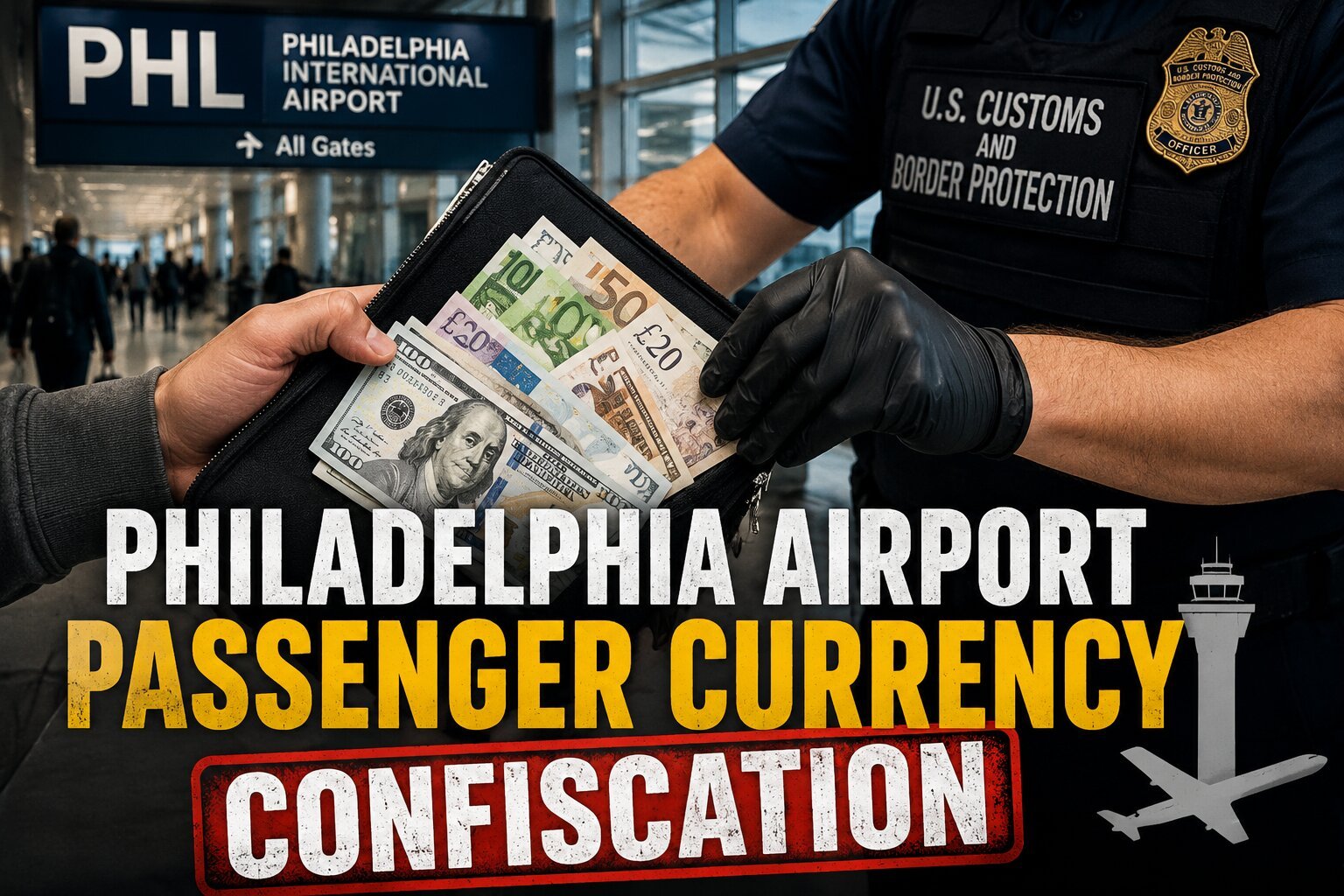
A $44,000 Seizure and a K-9 Named Nitro Send a Clear Warning to Travelers This Summer
On April 30, 2026, a 54-year-old traveler arrived at Philadelphia International Airport with one destination in mind: Cancun, Mexico. He left the terminal with almost nothing in his pockets. What unfolded that day is a cautionary tale for every traveler — domestic or international — who thinks they can quietly carry a large sum of cash onto a plane without telling anyone.
U.S. Customs and Border Protection (CBP) officers seized over $44,000 in unreported currency before the man ever boarded his flight. The culprit who caught him? A three-year-old chocolate Labrador retriever named Nitro.
What Happened at Philadelphia International Airport
According to CBP, officers were conducting routine outbound enforcement at Philadelphia International Airport when K9 Nitro — trained to detect bulk currency, firearms, and ammunition — alerted to the Mexico-bound passenger. Officers approached the 54-year-old American-Peruvian traveler and advised him of federal currency reporting laws, then asked him to disclose how much currency he was carrying.
The man declared, both verbally and in writing, that he had $10,000 on him — the threshold at which reporting becomes legally required. Under U.S. law, carrying exactly $10,000 does not require a formal declaration; it is when the amount exceeds $10,000 that travelers must file a report with the U.S. Treasury Department.
But Nitro had already done his job. A subsequent inspection revealed that the passenger had been anything but truthful. CBP officers found $44,690 in U.S. currency distributed across his pockets, inside separate envelopes, and hidden within his carry-on bag. More than $34,000 of that total had never been declared.
CBP seized the entire sum. As a humanitarian concession, officers returned $240 to the traveler before releasing him — just enough for the ride home.
The Warning from CBP Officials
Acting Area Port Director Elliott Ortiz of CBP’s Area Port of Philadelphia did not mince words following the seizure. “This traveler concealed currency in multiple locations for the purpose of evading federal currency reporting laws, but no amount of concealment can hide bulk currency from Customs and Border Protection officers and especially from CBP canine Nitro,” Ortiz said in an official statement.
His warning extended beyond this single incident. With the busy summer travel season approaching, Ortiz urged all travelers to be forthcoming: “CBP urges travelers to truthfully report all currency they possess to a CBP officer during inspection or face severe consequences as this traveler learned.”
The message is unmistakable — enforcement is active, K-9 units are effective, and CBP is not tolerating evasion.
Understanding the $10,000 Rule: What the Law Actually Says
One of the most commonly misunderstood aspects of traveling with cash involves the $10,000 declaration rule. Here is what every traveler needs to know:
The rule applies to international travel. If you are flying into or out of the United States and carrying more than $10,000 in currency or monetary instruments, you are legally required to report it to the U.S. Treasury by completing a FinCEN Form 105 — officially known as the Report of International Transportation of Currency or Monetary Instruments.
“Currency” is broadly defined. The rule does not just apply to cash. It covers monetary instruments including traveler’s checks, money orders, negotiable instruments, and cashier’s checks. If the combined total of what you are carrying exceeds $10,000, all of it must be declared.
The $10,000 limit is not per person in a group. This is a critical point that many travelers overlook. When traveling with family members or as part of a group, the $10,000 threshold applies to the total amount carried collectively, not to each individual. A family of four, each carrying $4,000, technically exceeds the limit and is required to declare the combined $16,000.
Carrying more than $10,000 is not illegal — failing to declare it is. This distinction matters enormously. There is no cap on how much cash you can travel with. The law only requires that you report it truthfully. The Philadelphia traveler was not arrested for having $44,000; he faced consequences because he lied about it.
Domestic travel is different. Within the United States, there is no federal requirement to declare the amount of cash you are carrying. The declaration rule is specifically tied to crossing international borders.
How to File the FinCEN 105 Form
CBP has made compliance relatively straightforward. Travelers can complete and submit the FinCEN 105 currency reporting form online at fincen105.cbp.dhs.gov prior to arriving at their departure gate. The form takes just a few minutes to fill out. Alternatively, travelers can request assistance from CBP officers at the departure gate before boarding.
There is no fee to file, no penalty for declaring large sums, and no reason to avoid doing so if your money is legitimate. The process exists to track and prevent money laundering and illicit financial activity — not to penalize honest travelers carrying large amounts of cash for business or personal reasons.
The Consequences of Getting Caught
The Philadelphia case illustrates just how severe the penalties can be for non-compliance:
Currency seizure. CBP has the authority to confiscate the entire sum — not just the amount above $10,000. In this case, the traveler lost nearly all of the $44,690 he was carrying.
Criminal prosecution. Beyond losing the money, violators face potential criminal charges for bulk currency smuggling. Under federal law, those charges can carry a prison sentence of up to 10 years and fines of up to $500,000 — consequences that far outweigh any inconvenience of filling out a form.
Missing your flight. CBP examinations that result in a seizure can be time-consuming. Travelers caught with undeclared currency risk missing their scheduled flight on top of everything else.
Civil asset forfeiture. Even if criminal charges are not pursued, CBP can initiate civil forfeiture proceedings to permanently keep the seized funds. Recovering confiscated money is a lengthy and often expensive legal process with no guaranteed outcome.
Meet K9 Nitro: The Dog That Caught $44,000
Central to this story is a three-year-old chocolate Labrador retriever named Nitro. Trained to detect bulk currency, firearms, and ammunition, Nitro is part of CBP’s K-9 enforcement program — one of the most effective tools in the agency’s border security arsenal.
K-9 currency detection dogs like Nitro can identify the distinct scent of large quantities of cash that humans cannot perceive. No matter how carefully currency is concealed — whether in sealed envelopes, buried in luggage, or hidden in clothing — a trained dog’s nose can find it. In this case, Nitro alerted before officers had even finished questioning the passenger, effectively sealing the outcome before the conversation ended.
The Bigger Picture: How Much Is Being Seized Nationally?
The Philadelphia incident is not an outlier. CBP data paints a striking picture of how widespread currency enforcement has become across U.S. borders and airports. In fiscal year 2025, CBP officers and agents seized approximately $180,000 in unreported or illicit currency every single day — adding up to roughly $66 million for the full year, a figure higher than both 2023 and 2024. As of March 2026, seizures for the current fiscal year had already reached $37.9 million.
Airports with particularly active enforcement operations include Philadelphia International, John F. Kennedy in New York, Los Angeles International (LAX), and Miami International — all major international departure and arrival hubs where outbound and inbound enforcement is routine.
Practical Tips for Travelers Carrying Large Amounts of Cash
Whether you are a business traveler, a tourist, or someone sending money abroad, here are the most important steps to take before flying internationally with significant amounts of cash:
Know the threshold. Any amount over $10,000 in monetary instruments must be declared when crossing U.S. borders.
File before you fly. Complete the FinCEN 105 form online at fincen105.cbp.dhs.gov before you reach the airport. Do not wait until you are at the gate.
Carry documentation. If you are transporting large sums for legitimate reasons — a business transaction, a property purchase, a family emergency — carry documentation that explains the source and purpose of the funds. Bank statements, contracts, or legal letters can help demonstrate the legitimacy of what you are carrying.
Never underreport. The lesson from the Philadelphia case is clear: declaring $10,000 when you are carrying $44,000 is not a gray area. It is a federal violation with serious consequences.
Consider digital alternatives. For large international transactions, wire transfers and digital payment platforms can often serve as safer, more traceable alternatives to carrying physical cash, eliminating the risk of confiscation entirely.
Ask for help if unsure. CBP officers at departure gates are available to assist travelers in completing the FinCEN 105 form. If you are uncertain about whether or how to declare the currency you are carrying, asking is always the right move.
A Timely Reminder as Summer Travel Peaks
With the summer travel season ramping up and millions of Americans preparing for international trips, the Philadelphia Airport case serves as both a warning and an opportunity. The warning: CBP enforcement is active, well-trained, and effective. The opportunity: compliance is easy, free, and fully protects travelers who are carrying legitimate funds.
The rules around currency declaration are not designed to trap honest travelers — they exist to stop money laundering, drug trafficking proceeds, and other illicit financial activity from crossing borders undetected. A traveler with nothing to hide has nothing to fear from a form that takes five minutes to complete.
Nitro and his colleagues will keep working the terminals this summer. The question is whether travelers will choose to comply — or learn the hard way, like the man who boarded a Cancun flight with $44,690 and left with $240.