

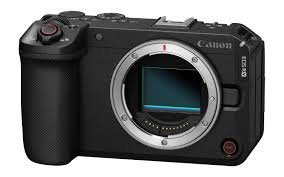
Canon has done it again. Just when photographers and videographers thought the EOS R6 lineup could not get more interesting, Canon has officially unveiled the Canon EOS R6 V — a bold new mirrorless camera that makes a very clear statement about where Canon sees the future of content creation heading. With a built-in cooling fan, jaw-dropping video specs, and a sleeker body, the R6 V is a camera that demands your attention — even if it comes with one significant trade-off that will divide opinion.
Let us break down everything you need to know about this exciting new release.
What Exactly Is the Canon EOS R6 V?
The Canon EOS R6 V is the latest addition to Canon’s growing “V series” — a lineup specifically designed with video creators, hybrid shooters, and content creators in mind. It was unveiled alongside the new RF 20-50mm f/4 L IS USM PZ lens and an array of new hybrid creator-centric accessories.
At its heart, the Canon EOS R6 V is built around the same 32.5-megapixel full-frame CMOS sensor that first appeared in the Canon EOS C50 and then the EOS R6 Mark III — PetaPixel’s Camera of the Year 2025. So right from the start, you know you are getting a seriously capable imaging platform that has already proven itself in the real world.
But the R6 V is not simply a rebadged R6 III. Canon has made some deliberate and meaningful changes — both additions and removals — that give this camera its own distinct identity and purpose.
The Biggest Change — No Electronic Viewfinder
Let us address the elephant in the room straight away. Unlike the R6 III, the R6 V lacks an electronic viewfinder (EVF), so users must rely on the rear display for all composing needs.
This is a significant design decision and one that will immediately split potential buyers into two camps. For dedicated photographers, street shooters, and action-oriented hybrid creators, the absence of an EVF is a real drawback. Shooting in bright sunlight without a viewfinder can be genuinely frustrating, and many photographers rely on the EVF for precise manual focus and detailed exposure assessment.
However, Canon clearly made this decision with a very specific audience in mind — video creators, vloggers, live streamers, and content creators who spend most of their time looking at a flip screen or external monitor rather than squinting through a viewfinder. For that audience, the EVF removal is unlikely to be a dealbreaker — and the benefits Canon has added in its place more than compensate.
The removal of the EVF also makes the R6 V a bit smaller than the R6 III — a welcome change for creators who carry their camera all day or travel frequently.
The Game-Changing Addition — Internal Cooling Fan
This is where things get genuinely exciting. One of the most frustrating limitations of any mirrorless camera used for professional video work is thermal throttling — the point at which the camera overheats and automatically stops recording to protect its internal components. It is a problem that has plagued countless shoots and frustrated videographers for years.
Canon has addressed this head-on in the R6 V by building in an internal cooling fan — a feature the R6 III does not have — and the results are dramatic.
The R6 V should be able to record 4Kp60 video at room temperature for two hours, a roughly fourfold increase compared to the fanless R6 III. As for 7Kp30 Open Gate recording, that has increased from 33 minutes to as long as there is sufficient power to keep the camera running.
Let that sink in for a moment. Unlimited 7K Open Gate recording limited only by battery life — not heat. For professional videographers, documentary filmmakers, event shooters, and live streamers, this is a transformational upgrade. No more anxiously watching a recording timer count down. No more missed moments because your camera decided to take a cooling break at the worst possible time.
Video Specifications — Built for Serious Content Creation
The R6 V is not just about recording longer — it is about recording better. The video specifications on this camera are genuinely impressive and position it as one of the most capable mirrorless video cameras in its price range.
Here is what the Canon EOS R6 V can do:
- 7Kp60 RAW Light recording for maximum quality and flexibility in post-production
- 7Kp30 Open Gate for unlimited recording sessions
- Oversampled 4Kp60 for stunning ultra-high-definition footage with incredible detail
- 4Kp120 for buttery smooth slow-motion footage
- Slow and fast motion video modes for creative flexibility
- In-body image stabilization (IBIS) — the same system found in the R6 III
It has the same autofocus system as the R6 III — which is one of the best in the business. Canon’s Dual Pixel CMOS AF has long been praised as the gold standard for video autofocus, and having that same reliable, fast, and accurate system in the R6 V means creators can trust their footage will stay sharp even in challenging shooting conditions.
New Creator-Focused Features
Beyond the fan and the EVF removal, Canon has packed the R6 V with several thoughtful new features that make it an even better tool for modern content creators:
Zoom Lever — A physical zoom lever has been added, designed to work seamlessly with the new RF 20-50mm f/4 L IS USM PZ power zoom lens. This gives videographers smooth, consistent zoom control during recording — something manual zoom lenses simply cannot replicate.
Front-Mounted Secondary Movie Record Button — A second record button on the front of the camera makes it much easier to start and stop recording when the camera is mounted on a tripod or gimbal in unconventional positions.
Instant Live Stream Button — Dedicated live streaming has become a core part of modern content creation, and Canon acknowledges this with a dedicated instant live stream button for fast, one-touch broadcasting.
Second Tripod Mount for Vertical Shooting — With vertical video dominating social media platforms, Canon has added a second tripod mount specifically designed for vertical orientation. This is a small but incredibly practical addition for creators who produce content for Instagram Reels, TikTok, and YouTube Shorts.
What About Still Photography?
Although decidedly not a photo-first camera, Canon has not stripped the R6 III’s key features away from the video-centric R6 V.
It has the same imaging pipeline as the R6 III, which means it can shoot full-resolution photos at up to 40 frames per second using its electronic shutter, along with pre-continuous shooting.
That said, there are some meaningful limitations for photographers to be aware of. The lack of a mechanical shutter means photographers are giving up some dynamic range compared to the R6 III. Additionally, the lack of an EVF could conceivably limit the R6 V’s utility for action photography.
In other words — the R6 V can absolutely take great photos, but it is engineered first and foremost for video. Photographers who need the best possible stills performance will still be better served by the R6 III.
Where Does the R6 V Fit in Canon’s Lineup?
Canon’s creator-focused lineup is getting quite crowded. The R6 V sits at the top of the V series pyramid, offering more advanced features and higher performance than the APS-C Canon EOS R50 V and significantly more performance than the PowerShot V1. On the other hand, the R6 V lacks the Cinema EOS capabilities of the C50.
Think of it this way — the R6 V fills a very specific and previously underserved gap in the market. It is more capable than entry-level creator cameras but more accessible and creator-friendly than full Cinema EOS cameras. For the serious YouTube creator, documentary filmmaker, event videographer, or social media professional who needs professional-grade video in a versatile mirrorless body — the R6 V makes a compelling case.
Pricing and Availability
The Canon EOS R6 V will be available in late June for $2,499. There will also be a new kit with the new RF 20-50mm f/4 L IS USM PZ lens for $3,699.
At $2,499 for the body only, the R6 V sits at a premium price point — but one that feels justified given the sensor quality, video capabilities, and the addition of the internal cooling fan. The kit option at $3,699 with the RF 20-50mm power zoom lens is a particularly attractive bundle for creators who want a complete, ready-to-shoot video setup right out of the box.
Final Verdict — Who Is the Canon EOS R6 V For?
The Canon EOS R6 V is a camera with a very clear and deliberate identity. It is not trying to be everything to everyone. Canon has made a calculated decision to prioritize video performance, extended recording capability, and creator-friendly features over the traditional photography tools that define cameras like the R6 III.
If you are a video creator, live streamer, vlogger, or hybrid shooter who values long recording times, top-tier video quality, and practical creator features — the R6 V deserves serious consideration. The internal cooling fan alone is a genuine game changer that solves one of the most persistent frustrations in mirrorless video production.
If you are primarily a photographer or a hybrid shooter who relies heavily on an EVF and a mechanical shutter — the R6 III remains the stronger choice.
Either way, Canon has delivered a camera that pushes the conversation around what a mirrorless camera can be — and that is always worth celebrating.
The Canon EOS R6 V launches in late June 2026 at $2,499 body only and $3,699 with the RF 20-50mm f/4 L IS USM PZ lens kit.